Wednesday, August 21, 2013

A Faux Living Card

Hello Everyone!!  Today I have something a little different for you.  How many of you have seen a Living Card?  They are the cards you can buy at a florist complete with a living plant/flowers inside.  They look something like this....
Now I don't know about you, but in my house, plants have a very short life span!  So, I thought, how could we make a FAUX Living Card?  That was it would last for and be enjoyed for a lot longer!  :)

I decided to use the Flourishes' Hollyhocks stamp set and picked out the Copic colours that I thought would work well.  (Hollyhocks is a new stamp set available through X-press Graph-x, contact them for details!!)
I had a look at the image I was planning to colour and stamped it three times in Memento Tuxedo Black onto X-press It Blending Card.
The first image I've coloured the top of the image in full detail.  The bottom I've I've only applied the base colour because this will be covered by other layers.  This way if there are any parts peeking out from underneath the layers it won't be noticeable, but you aren't spending a lot of time or ink colouring it either.
For the second image, I've coloured only the bottom part of the image.
For the third image, I've only coloured small parts that look like they would be in the foreground - for example the flowers that are in front of others.
Next I cut out my three images.  You don't have to cut out your base image, but I had a plan for mine and did so - which is a LOT of fussy cutting!  The second image is all one piece and the third image is in six pieces.  It's really important that you cut the layer pieces close - you don't want those white lines around them!
Add some X-press It High Tac Foam Mounting Tape to the backs of each piece (except your base image).  I like the High Tac because it really holds the pieces where you want them to be.
Take your second image with the foam tape attached and place it over your base piece.  Make sure you line it up well so that you can't see the image underneath!
Then attach all your individual pieces, also on foam tape and carefully attach them, once again covering the image underneath.
So now that your image is full of dimension, how can we make this into a Faux Living Card?
Take a piece of card, scoring it twice in the middle to create a wide spine.  I've made this one to fit the die cuts from Spellbinders Elegant Labels Four dies.  I've cut white with these dies to create a beautiful frame and background for the Hollyhocks.
The sentiment is also from Hollyhocks stamp set and I've cut it out using the die from Spellbinders 5x7 Detailed Scallops, airbrushing the middle using R81 Copic.
And there you are!!  Your very own Faux Living Card, one that will not die and your recipient will treasure forever!

The Copic Colours used in today's Faux Living Card Tutorial are.....

Leaves - G40, G43, G46, G94, C5
Dark Pink Hollyhocks - R81, R83, R85, R89
Purple Hollyhocks - B60, B63, B69, B37
Light Pink Hollyhocks - RV00, RV52, RV55

Hope you've enjoyed today's tutorial! 
Happy Colouring!
Kathy

Pin It

Wednesday, August 7, 2013

Copic Art Journaling #3: Learning to doodle


Hi All - it's my turn to share some more ideas with you all to use in your Copic Art Journal, and this week I'm hoping to inspire you to try your hand at doodling.. 

There are many types of doodling, there is the increasingly popular Zentangling, there is tangling, there is Stentangling, and there are doodles - Phew no wonder people get confused!  Today I am talking about simple doodling, this is often quick, fun and once you begin it's difficult to stop.
Whether you know it or not, most of us doodle without even realising it.  It can be as simple or as fancy as you like, the doodle itself can be the art or it can compliment the art. My job today is to give you some ideas so you can begin to incorporate these little drawings into your Copic Art Journal - or any art.

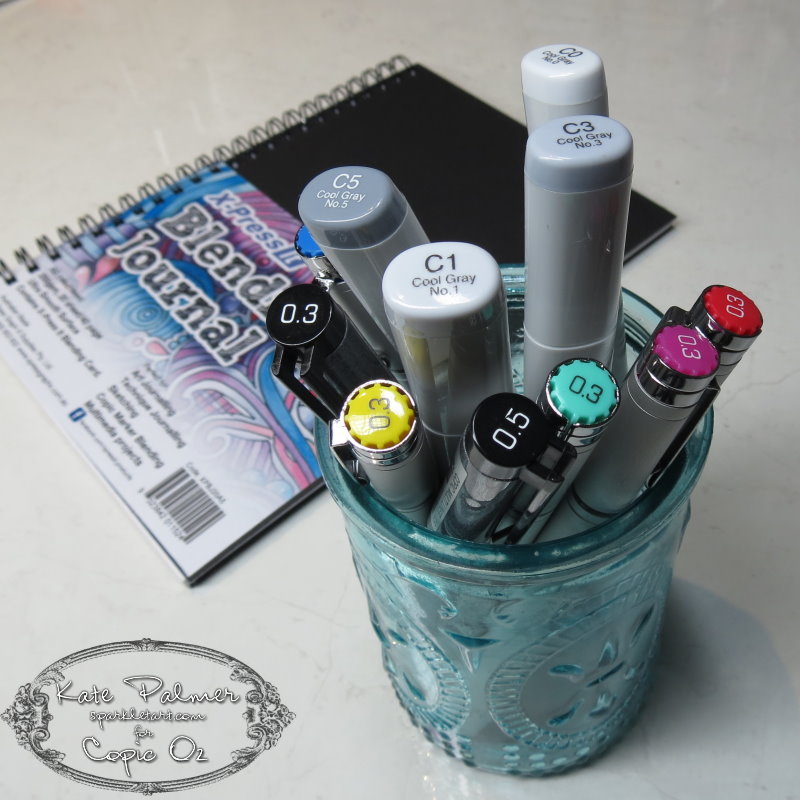
These are the basics that you will need to begin doodling in your Copic Art Journal:
  • Copic Multi-Liners in a variety of sizes and colours 
  • Set of Grey Copic Markers either: T0, T1, T3, T5 or N0, N1, N3, N5  for adding shadows
  • XPressIt Blending Card or the XPress It Blending Journal
  • Rubber stamps with an open design
  • Stencils with an open design
  • Your imagination!

WHAT TO DOODLE?

What is a doodle anyway?  Wikipedia defines a doodle as:  'an unfocused or unconscious drawing made while a person's attention is otherwise occupied. Doodles are simple drawings that can have concrete representational meaning or may just be abstract shapes.'

But where do you start - what should YOU doodle?  This is a tough one as doodling is very personal, I can tell you I love to doodle circles, lines and floral patterns - but these designs may not be interesting to you.  I sometimes doodle images, other times I just doodle shapes or patterns - it's all doodling.  The easiest thing to do is to look around you, can you see a pattern a shape that you like - then try doodling those or drawing them and doodling within those shapes.  It's much easier to do if you draw something you like.

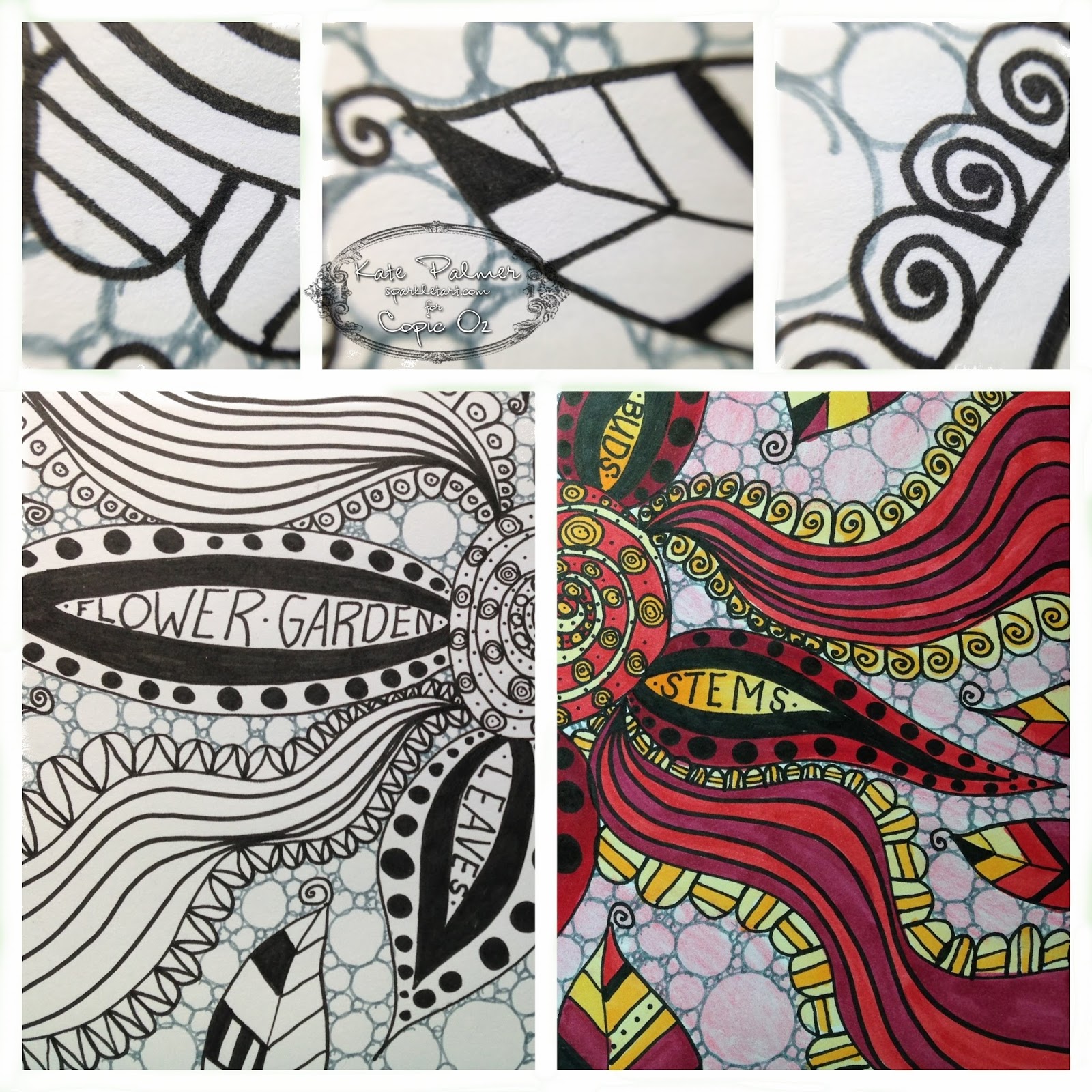
Here are a few ideas, simple things I doodled with my 0.5 Copic Multi Liner while watching TV, see they don't have to be amazing!  If you need a bit more inspiration you can check out  my 'Doodles' Board over on Pinterest.  To find your doodles try drawing some squares (about 5cm x 5cm) and just draw little doodles within these, then use these on a larger scale.  These simple doodles, look more interesting when viewed as a whole and even better coloured with Copics!  The joy of doodles is that they can be as simple or as complex as you like.

This is where I got really excited about doodling, with a little colour and a bit of confidence, you can easily incorporate your doodling into whatever art or craft you already create, why not doodle on small pieces of card stock and turn these into the main element on a card, or bookmark or even framed art, or doodle designs around your photos on your scrapbook pages.  Once you begin the possibilities are endless.

WHERE AND HOW TO USE DOODLES?

Give these ideas a go.....

Doodle on Stamped Images

Using a Copic safe ink like Memento, stamp your image onto your card or journal.
Add doodle designs with Copic Multi Liners to part or all of your stamped image, here I've doodled designs onto Marci's Kimono to add a pattern.  Whether your image is stamped, collaged or drawn, this is a fun way to add a little whimsy to your art.  Try a doodle hair-do, or doodles on a dress, even a doodle body to draw attention to the focal image.


Use Stencils to create a doodle pattern

Using your Copic Multi Liner (I like Grey or Black) use a stencil to draw a pattern onto your card or journal.   Using the pen of your choice, fill in around the pattern or within the pattern (or both) with doodle designs.    Leave it as is or add colour if desired.   Use your doodled designs to decorate planners and diaries or filing folders.  I can't be the only person who still uses a diary or smash book!  Get to it and start dressing up your dividers with a doodle or two, come to think of it you could apply this to your files for work or home, address books, recipe cards etc.

Doodle Within or Around Letters or Images

Using your Copic Multi Liner draw bold a capital letter (or word) with space inside the letters to add doodling or colour.  Use your favourite supplies to add doodling either within the letters or around the letters, again coloured or uncoloured the choice is yours.  On a more manageable scale, this would make wonderfully fun and personal name tags or place tags for weddings and parties!


Doodle Within Shapes (or get fancy and have the doodle create the shape)

Here are 2 examples of what I mean:
1. Try drawing a heart (or a few) and adding doodling within or around the shape to embellish it, smaller shapes are best with single patterns, larger shapes can handle a few different patterns at once.  Now I chose a heart, you may prefer a flower, a circle, an animal - pick a shape and have a play.  You can use these simple doodles on cards or page backgrounds, and it's all drawn by you - so an original piece of doodle art! 


2.  Draw your heart in pencil and doodle around or within it, then rub out the pencil - your designs create the shape,  I really do love the Copic Multi Liners for this, the coloured ones in particular.   Now just a note here, if you draw over lead pencil with either Copic markers or Copic Multi Liners, then the pencil covered by the Copic will not erase - strange but true.


Doodle Backgrounds

Enhance your art by using doodles and doodle patterns in your backgrounds, a little or a lot it's up to you - just make sure you are using pens which won't bleed if you decide to colour over the top - I love the Copic Multi Liners for just this reason - they are life proof!  When you are feeling a bit more confident, try creating scenery with doodles or using doodles as your art.  Doodles aren't just 'unconscious drawing' anymore - they are now entering the realm of DOODLE ART.  
Face coloured with Copic markers, fine details added with coloured pencils,
 hair coloured with Silks - all doodling created using 0.3 & 0.5 black Copic Multi Liners.

Do you you remember the doodle right from the beginning of this post - the one I drew while watching TV?  This is what I used it for, I added a little stenciling, some gold foil, stamping, black paint and white Molotow marker and turned it into this, even the simplest doodle can turn into something special.

    May your day sparkle and happy doodling,
    Kate
    Enhanced by Zemanta
    Pin It

    Wednesday, July 24, 2013

    Bark and Chipboard


    Hello Everyone and welcome to another Copic Oz tutorial!  Today I'm playing with Chipboard and Sticky Barc!  Sticky Barc is a new product which are self adhesive sheets of ultra then wood - made of REAL wood!  You can stamp, ink, colour, varnish and anything you would normally do with paper, you can do to these wood sheets as well!  Oh, you can even put them through your inkjet printer!!  How Cool!!  :)

    As you can see, there is a removable backing sheet on the back of your sticky barc sheet.


    Did I mention you can die cut it??  This piece has been cut using the La La Land Crafts Heart Fence Die.

    I really like the look of the fence cut with this wood, however, I've decided to give it a bit of a golden effect by colouring with Y21 which is a lovely buttery yellow!

    How about Chipboard?  

    You can colour chipboard in exactly the same way, by simply colouring direct from your marker, or even airbrushing!!  Remember the chipboard is darker and very absorbent, so lighter colours don't show as well.  I've used RV55 which is a mid-toned pink.
     
     Of course, you can leave your chipboard like this and it looks great, or you can apply some X-press It Clear Gel glue for a glossy effect!  (Make sure you have a scratch mat underneath!!)


    Even out the glue with your finger so that all parts of your chipboard are covered evenly!


     Use your Sticky Barc and Chipboard to create a sweet hanging piece of art - I thought this would be cute in my daughter's room!  :)


    Hope you've enjoyed today's tutorial!  Why not play around with some new surfaces and see what fabulous projects you can create??!!

    Happy Colouring!
    Kathy

    Pin It

    Wednesday, July 10, 2013

    Art Journal #1 Creating Backgrounds

    Hello and welcome to the first in our series of posts all about creating in your Copic Art Journal!  I have received quite a few questions since posting my first Copic coloured Art Journal Page, lots of people saying they didn't have the time to doodle and colour, others saying an all Copic page would use too much ink!  Well I'm here to tell you that colouring the whole page with markers isn't the only way to use Copics in your journal.  To give you all a little head start, today I'll show you 5 simple techniques that you can use to create Copic backgrounds in your journal and then I will be creating a page using these techniques to show you how it could look.  I am working in my fabulous X-Press It Copic Blending Journal as it is created with Copic blending card and perfect for Copics and journaling!


    Technique 1: Spritzing with Copic Ink 

    You can do this in one of 2 ways, add Copic Various ink to a mini mister and spritz (the colours will be quite strong and you will use a fair bit of ink) or what I've done here, pick a strong colour (eg Black 100) and add 3 drops to a mini mister bottle followed by 3mL of Copic Colorless Blending ink (if you look on the side of the Various reinkers it is marked in mL to make it easy).  If you push the pump nozzle quickly you get a fine even mist, if you push slowly you get a splattered look, you can see both below.

    Spritzing


    Technique 2: Stencilling  with Copic Ink 

    Use the same ink and blender mixture as from Technique 1 and use this to mist through stencils - don't spray too close to the stencil or liquid can seep underneath and make sure you are working in a well ventilated room.

    Stencilling

    Stencilling


    Technique 3: Copic Various Ink drips

    This is one we usually try not to do, but today you are going to tilt your card and add drips of Copic Various ink straight from the bottle, the resulting colours are quite strong, so use this sparingly.

    Drips 1


    Technique 4: Copic Various Ink drops

    Something else we usually avoid, drip Copic Various ink onto a non-stick surface, add a drop of Colorless Blender  to each drop and plop your project right onto the spots face down, you will create uneven blobs of colour.

    Trust the Mess Copic Journal Page 4 wm


    Technique 5: Stamping with Found Objects

    Grab any non-porous object (plastic, glass or china etc) use the chisel tip of your Copic marker to colour the surface, spritz your card with Colorless Blender and then firmly press the inked part of your object onto the wet card.  More blender = wetter card = more wicking of the ink, where as less blender = crisper image.  You can try this with jars, lids, leggo, toys etc.

    Trust the Mess Copic Journal Page 10 wm

    Found object stamping

    and these are the techniques I just showed you, being used to create my Art Journal page ...

     Mask edges of page with low tack tape, spray page with your favourite sparkly spray, let dry then then spritz page with Copic ink (Black 100 + Colorless Blender) - see you can combine sparkles and Copics!

    Trust the Mess Copic Journal Page 3 wm

    Use same Copic ink in mister bottle to add some stenciled words or patterns.

    Trust the Mess Copic Journal Page 3 wm

    Add drips of Various ink (BG15) directly to the page and add drops of ink as described previously (I used BG49 and BG15).

    Trust the Mess Copic Journal Page 6 wm

    Use jar and plastic lid to add stamped impressions, I coated objects with E29.

    Trust the Mess Copic Journal Page 6 wm

    Use old Copic Multi Liner Brush marker size M to stencil on some words, the stencils are hard on the marker nibs so don't use your best brush marker for this.

    Trust the Mess Copic Journal Page 6 wm

    Trust the Mess Copic Journal Page 6 wm

    Use 4B pencil to add shadows to lettering.

    Trust the Mess Copic Journal Page 12 wm

    Stamp Flourishes images from Magnolias and Hydrangea sets, using Mememto ink in Bamboo Leaves & Rich Cocoa and colour with pencils.

    Trust the Mess Copic Journal Page 12 wm

    Remove masking tape - there will be gorgeous little runs and specks of colour.

    Trust the Mess Copic Journal Page 12 wm

    and you have created something like this, if you look you can see all of those techniques used on this one page..

    Trust the Mess Copic Journal Page 12 wm

    I hope you have a great time trying these techniques for yourself, remember art is supposed to be fun so dive in and give Copic Art Journaling a go!

    Kate
    Enhanced by Zemanta
    Pin It